
Matrix
A matrix is a set of numbers arranged in rows and columns so as to form a rectangular array in two dimension. The numbers are called the elements, or entries. Matrices have wide applications in engineering, physics, economics, and statistics as well as in various branches of Mathematics.
If a Matrix has 2 elements in a row and 3 elements in column, it is called 2 x 3 or 2 by 3 matrix.
If a matrix have m rows and n columns then it is called mXn or m by n matrix.
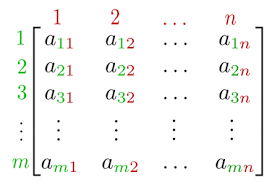
Where the elements are of the form (aij), located in the ith row and the jth column, is a scalar quantity; numerical constant, or a single valued expression. If m = n, that is there are the same number of rows as columns, the matrix is square, otherwise it is a rectangular matrix.
A matrix having either a single row (m = 1) or a single column (n = 1) is defined to be a vector.
A vector having a single row, is called row vector. Example:

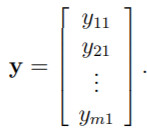
While a vector having a single column is defined to be a column vector. Example:
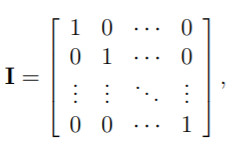
Two special matrices are the square identity matrix, I, which is defined to have all of its
elements equal to zero except those on the main diagonal (where i = j) which have a value of one:
Example:
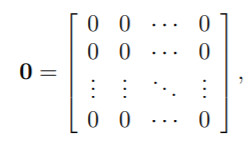
Null matrix or zero matrix is having all elements 0.
Matrix Addition
The operation of addition of two matrices is only defined when both matrices have the same dimensions. If A and B are both (m × n), then the sum C = A + B
is also (m × n) and is defined to have each element the sum of the corresponding elements of A and B, thus
(cij) = (aij + bij) .
Matrix addition is both associative, that is A + (B + C)=(A + B) + C,
and commutative A + B = B + A.
The subtraction of two matrices is similarly defined; if A and B have the same dimensions, then the difference C = A − B implies that the elements of C are
cij = (aij − bij) .
Multiplication of a Matrix by a Scalar Quantity:
If A is a matrix and k is a scalar quantity, the product B = kA is defined to be the matrix of the same dimensions as A whose elements are simply all scaled by the constant k,
(cij) = (k ×aij)
Matrix Multiplication Two matrices may be multiplied together only if they meet conditions on their dimensions that allow them to conform. Let A have dimensions m × n, and B be n × p, that is A has the same number as columns as the number of rows in B, then the product
C = AB is defined to be an m × p matrix with elements
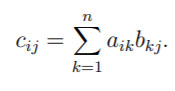
The element in position ij is the sum of the products of elements in the ith row of the first matrix (A) and the corresponding elements in the jth column of the second matrix (B). The product AB is not defined unless the above condition is satisfied, that is the number of columns of the first matrix must equal the number of rows in the second. Matrix multiplication is associative, that is A (BC)=(AB) C,
but is not commutative in general
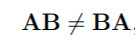
in fact unless the two matrices are square, reversing the order in the product will cause the matrices to be nonconformal. The order of the terms in the product is therefore very important. In the product C = AB, A is said to pre-multiply B, while B is said to post multiply A. It is interesting to note in passing that unlike the scalar case, the fact that AB = 0 does not imply that either A = 0 or that B = 0.
Linear Algebraic Equations
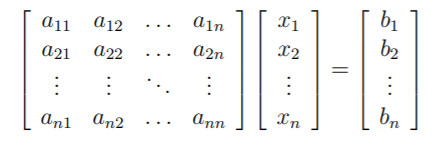
The rules given above for matrix arithmetic allow a set of linear algebraic equations to be written compactly in matrix form. Consider a set of n independent linear equations in thevariables xij for i = 1,…,n
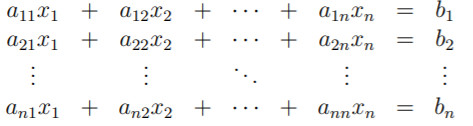
Let us write the coefficients aij in a square matrix A of dimension n.
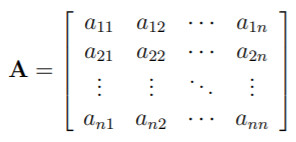
the unknowns xij in a column vector x of length N
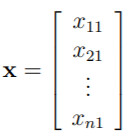
and the constants on the right-hand side in a column vector.
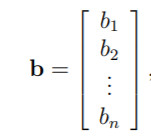
then equations may be written as the product,
Function of a Matrix
Transpose of a Matrix:
The transpose of an m×n matrix A, written AT, is the n×m matrix formed by interchanging the rows and columns of A. For example, if
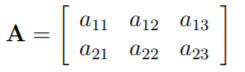
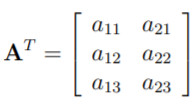
The transpose of a row vector produces a column vector, and similarly the transpose of a column vector produces a row vector. The transpose of the product of two matrices is the reversed product of the transpose of the two individual matrices, (AB)T =BTAT